Showing posts with label The Apartment Bedroom. Show all posts

Sunday, 28 July 2019

Dormer windows

I kind of sorted out the no-wallpaper problem, rather than just white paint the lot.  I quite literally had three small pieces of the green paper left over which got patched and joined together with a panel each side of the window and a piece beneath.  The hairiest part of that job was having such a large pattern which needed matching over very minimal pieces of paper, absolutely no room for error.  

I did this before Anna kindly offered to mail me a couple of sheets all the way from Australia.  [Thank you, Anna]  Not that she didn't comment and email me as soon as the post went up but the posts run close to what I am doing but I am often a little ahead of them in actual work. At least my having already fudged it saved me from  having to make another decision of how best to go about it.  I seem to be floundering a bit in that department right now.

As I didn't have any grey paper at all I did my best to mix a grey as close as I could get to the one in the room - it really needed a slight touch of blue but, as I keep saying, the inside of a roof flap really isn't an area which gets looked at.  It just needs to give a good impression of being finished.  I keep telling myself that.

The decorated sloping walls also have a small dado rail trim between the paint and the 'colour' as it might do in real life.


On to the windows

I prefer to cut all my trims with a saw and mitre block, even the thin ones.  My husband can go through them with a knife in a couple of passes - me?....  I find it nigh on impossible to use a knife through wood.

If you are cutting very thin trims like these you need to boost it up from the floor of the mitre block.  Generally you would add a piece of thick(ish) wood.  I didn't have any so a sacrificial eraser was used and it did just fine.


I use. 0.5mm clear acrylic for the windows and this can be cut with scissors but I find it seems to squidge all over the place between the blades so  I cut it with a very sharp, new blade, Xacto knife.  I also resort to overkill in terms of preparation.  Having once actually sliced a small piece off the end of my thumb I am super-wary of knives.

I make a template for the window (in this case I could use it to cut three windows this size).  I fasten this to my cutting mat with tacky wax (double sided sticky tape will do).  I lay the acrylic over the template and then I even tape that down with masking tape.  Both my hands are now free to focus entirely on holding a steel ruler in place and cutting along its edge.  I don't have to try and stop stuff slipping around at the same time.


This acrylic was a leftover from previous exploits and didn't have any protective film on it.  It was super-dirty and even a bit scratched.  I have better on order.  It is sensible to gently soap and water wash it before  you use it as any really gloppy finger marks or whatever can be a pain to remove once it has been transformed into a 1/12th Georgian window pane. 

This is terrific glue for putting in windows but doesn't come cheap.  That said it has lasted me through several builds.  It does dry clear so if you are a bit messy with glue it won'r ruin your glazing. It also gives you some working time to get things positioned correctly.  It is water based for easy clean up and does a great job of sticking acrylic to a painted surface.


I don't know about you but every time I come to a glue I haven't used in a while I have to go tunneling for the glue down a teeny little hole.  This is my weapon of choice and is just dropped in my handy-on-my-desk box.  It saves a lot of bodging with pins, needles, toothpicks, dental picks, fine tweezers and a gazillion other things I used before I 'invented' this.  It even comes with its own handle, what's not to like.  


So.....  a very small amount of glue round the edges of the 'glass' and press it into place. In this case, on the lower half of the back of the window frames.


all four sides eventually had glue


It was then just a case of adding trims to make the bottom (inside) half of a sash window.  there will be architrave trims round this when they arrive. plus roller blinds to tweak it up a little and conceal even more dubious finishes.


I may have thoroughly shot myself in the foot with my latest dopey idea to 'improve the basic build.  Painting 27 sticks, cutting 264 smaller pieces very accurately, cutting two pieces of glazing for every window rather than one and then assembling this lot to make 16 'mock' sash windows is most probably very pointless.  As you all know once you set off on one of these paths there is no going back.  

Clearly that wasn't challenging enough, so I decided authentic windows needed those little nubs on the frame to stop them thumping down or up.  These require spot on measuring and judicious carving and sanding of just the right amount of stick to shape them and...... hey.......  I only have 64 of these to make.

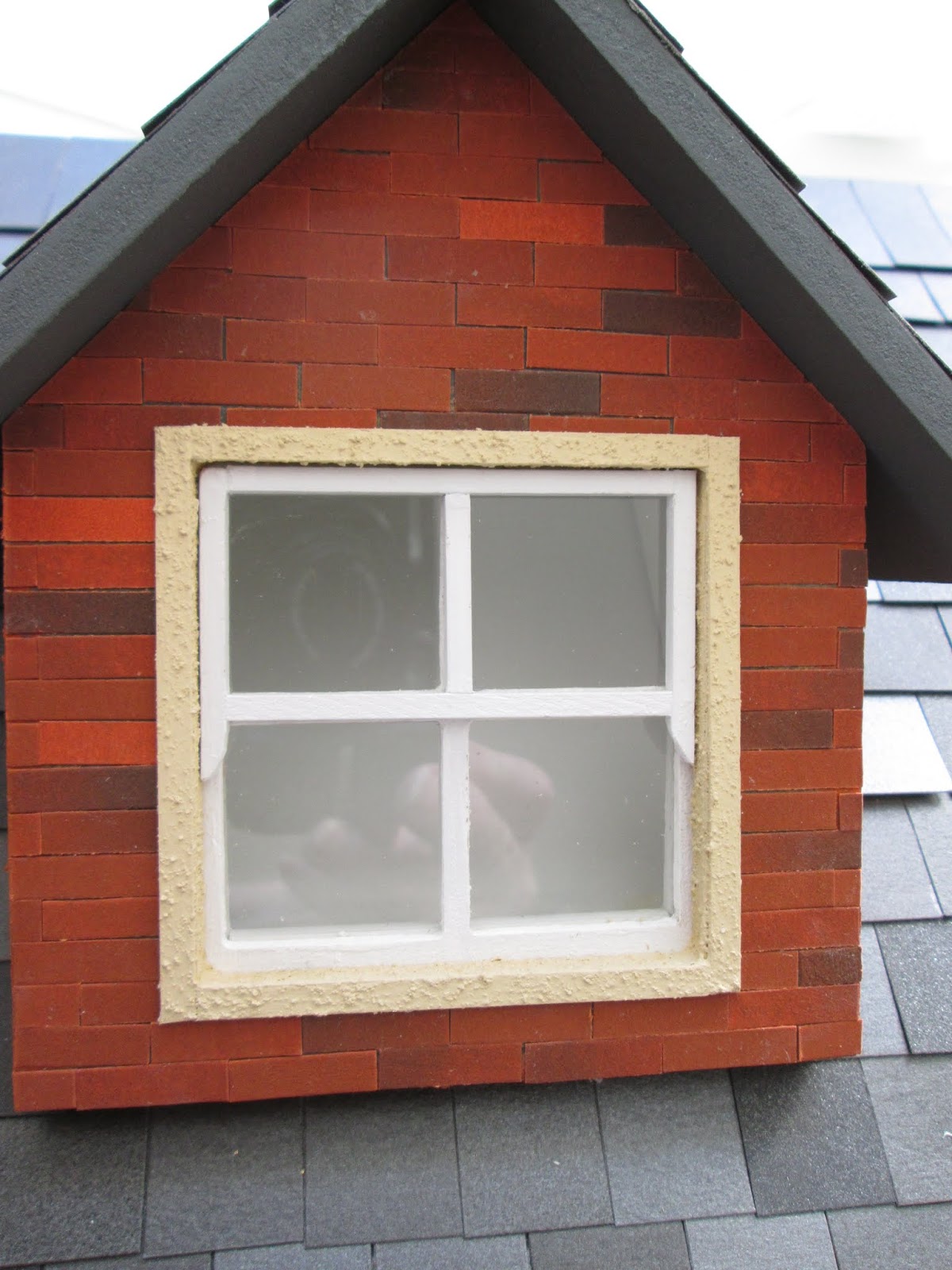
Here is the before and after photo of the outside.


before
after


before


after

Yes, I know it is not earth-shatteringly amazing but it feeds the soul of a slightly bonkers mini-enthusiast.

Monday, 22 July 2019

The fourth Wall

I am pretty much all finished with the construction and decorating of each room.  I have a few locks, alarms and (mock) electrical outlets of various sorts to add in, otherwise the rooms are done; so it is on to the fourth wall.

I suspect there may be extremely well-organised and finely tuned planning type folk who do any work on the inside of the wall before it even gets attached to the house.  This is not for me I'm afraid.  I want the whole outside of the house done first.  I am sure it is a sort of psychological thing of working on a (real-to-me) completed building.  The exterior finishes might then 'suffer' if they were laid down to allow work to be done flat on the table when doing the inside.  I also want the doors and roof on fairly quickly to reduce the amount of dust collecting inside the house.  My two main fourth walls, therefore (for me), have to be tackled in situ, which means working on a vertical plane.


The big debate


There are various schools of thought when it comes to finishing the fourth wall of an English-style dollshouse.  


1. Some feel it is best simply painted in a muted colour and left alone so that it doesn't detract from the finished rooms when you open the doors.  This seems a very reasonable stance to me and makes for an easy finish to the project.

2. Others feel the fourth wall should look exactly as it would if it were actually a fixed wall in the house.  It is therefore completely decorated and trimmed and dressed and even furnished by attaching furniture to the wall or making a small platform for it, also attached to the wall.  Generally these folk, treating it literally as the  fourth wall of their room, will complete this area at the same time as doing the other three walls.  One room at a time.   This seems a very reasonable stance to me and makes for an easy finish to the project.


3. I never have any idea of which way to go.  On every project I have honed my procrastination skills in respect of the fourth wall and just entirely ignored it until I have to deal with it.  I have then gone on to compromise and try to find a middle ground where the walls get decorated and the windows dressed and I leave it at that.  Any furniture standing against that wall simply stands in the house.  That takes some thinking about as you don't want to see the backs of most things or obscure the view, but there is usually some sort of wriggle round it if you choose the item carefully. 


I am very happy with this level of distraction that the decorated 'doors' create when viewing the open house and it does mean that the windows look finished when seen from the outside.  That will do nicely for me.  
This seems a very reasonable stance to me and makes for an easy finish to the project.

Feel free to go with any of these three or your own mix, there is no right or better way to finish the fourth wall.


Let's start with the dormer


When you start any work of any kind, it is wise to sort out every little thing you are going to need before you begin.  In this case two kinds of trim, two kinds of paint, wallpaper, two kinds of glue and a bunch of different tools such as scissors, saw, mitre block, brushes, rules, pencil, eraser and probably more.  This is a vital step - you will understand why later.


I find it impossible to work on a roof flap in situ - the height of the house means I would be working on a step-stool and everything would be upside down: I, therefore, removed the roof from the main house and flipped it over to work on.


I was nervy about doing this as I didn't want to damage the finished work on the outside.  Luckily it seemed to be OK and everything was lying neatly in place underneath


Here comes another 'don't skip this' step.  Make a (very scribbled) plan of what you intend to do.  This helps in a few ways.  Firstly the orientation has been flipped and your left is now your right, so it is important to be clear which colour paint or wallpaper goes in which place.  You want to think about any trims you might want to add and how they will interact with the edges of the room and trims you have in there.  They must be clear of those edges or the roof won't close properly.  In my case I also needed know where I wanted the white paint to go and I like to avoid drawing all over the actual piece and marking up with pencil.  It often bleeds into glue or paint if you leave it behind and it is sometimes hard to rub out.  I like to have the measurements all worked out on my diagram and then use masking tape to outline the various spaces.  I don't want to be continually working out what goes where as I go along; so, the rough sketch with measurements keeps me on task.


Eventually I want to improve all the windows in my build and try and make them look like sash windows.  I will need to add a lot of trims (starting with the dormer) and I always like this sort of thing to be ready to go when I need them so, although I only need a few for the dormer, I may as well paint the lot.  There are a couple of pieces of dado rail here too that I will be using.


Another handy tip..... buy the very best quality trims you can find/afford.  I get some very good quality wood ones from J & A Supplies when I am at a show, but I can't see them on his website.  I didn't do this with these trims (1/8th inch x 1/8th inch square).  I wanted so many I bought a ton of cheap ones from Hobby's.  They immediately want to bend as soon as paint touches them [painting all four sides pretty much mitigates this] and they are not super smooth to begin with and the wood produces quite a lot of nubs when wet.  All this will be manageable but better quality can save you some blood sweat and tears.

Here is my quick way of painting these -

Dab some generous dobs of paint along one edge.....


....... rub it along the wood gently, keep dobbing and rubbing all the sides and work your way along the trim roughly a third at a a time.  Leave them to dry.


I did the maths and I painted 27 trims x 19.5 inches x 4 sides x 2 coats and that's about 350 feet of fiddling with paint.   Don't be deterred it is a pretty pleasant mindless task and they only took a little over two hours..


Dormers are notoriously badly made - it is not my assembly skills - more the maker's design/cutting.  The worst of this particular one is the bottom of the window which luckily is a sort of overhang and looks fine from the outside but from the inside there is a decided gap.


I covered this with a piece of (already painted) leftover simple coving.  The configuration doesn't make a lot of sense in real life world but will suffice for this roof flap which is never really scrutinised and merely gets lifted up out of the way.


Each side of the roof has the wallpaper areas outlined with masking tape so the rest can all be painted white.  The centre room will be all white as it is the kitchen, so there are only two small wallpaper additions needed.


As I said the inside edges were pretty gappy.......


.........  but a coat of paint improved them greatly


I always make a template for any wallpaper even ones that seem to be simple rectangles (they never are).  The wallpaper itself is not particularly cheap or easy to find so best to get it right first time.  This template is just a piece of ordinary A4 printer paper.


After painting I had two areas like this waiting to be papered.


Here comes a bit of an aside.   Way back when, I bought an A1 portfolio very cheaply from eBay which stores my wallpaper beautifully; no rolling and then trying to flatten it, no knocked up edges or grubbiness.  I commend it to you.


This is where tragedy struck and my following my first instruction would have been useful.  I don't have any green wallpaper big enough to cover the space.  Yes, I have checked here there and everywhere on line and no one has it.  It was on its way out of Dolls House Emporium when I bought it on sale several years ago.  A couple of other folk had it but they don't any longer.

 As for the grey paper I don't have a shred of it.  There is absolutely no hope of getting this one as I bought years ago from some Etsy maker (in New Zealand I think!) who made to order and was also 'winding up'.  I did waste a lot of time 'just checking' though.

I have a white flap with two unpainted areas waiting to be covered.  I could just paint them white and get on with it but I had already measured and drawn up a plan and painted and cut dado rails and masked and carefully painted, all with a view to papering... .... all of which was a complete waste of time and brain power if I just ended up with a white flap.


So the current state of play is me walking away and controlling the urge to rant or cry and eventually coming up with a not very great solution.  Come back next time if you can stand the excitement of watching paint dry.


Sunday, 23 June 2019

Last (but one!) lap on the lighting


I am very proud of me:  I actually did what I said and finished putting in the last of my lights today.  I seem to have saved up one ceiling light, four table lamps and one standard lamp.

Here's a quick review of putting in a ceiling light - they are the easiest ones to do.  Just make sure you know exactly where you want it in the room and measure carefully or even better make a template.  If I want one in an 'odd' place I make a template of the floor - sounds 'posh' - all I mean is cut a piece of paper to fit the floor.  I, then, position furniture on it and mark where I would the ceiling light to go.  This is useful for a light over a dining table for example.  I then take the template upstairs to the floor above and make sure it is lined up with the front edges and  the side edges of the room below and make a mark through the paper where I want to drill the hole for the light.

If you have room in your tool storage area this is a convenient way to keep your drill bits


Always cut off any straggly exposed wires, they are a pain to thread through holes


It is much easier with a fairly rigid piece of wire.


I normally apply a little superglue (it must be the gel version) with a cocktail stick to the back of the light fitting; this is short cutting it.  I also usually remove the sticky tabs lights that come with most lights and put the glue on the rim  I don't like how they stick out from the ceiling and they don't have very strong glue on them.  This one was very thin, didn't show,  so I just left it in place


Pull wires through gently and get it in position preferably in one go.  Make sure if there is a wire exit hole on your light it is at the back so it can't be seen.  A helper here is handy - press and hold in place until the glue 'takes'.


Every time I mess about with a light I test it just to check it is OK


This is easily done by stripping the wires again and holding on each terminal of a 9 volt battery


If you want even more detailed explanations of putting in lights - showing grooves in the floors etc just click on the 'Lighting' label on the left and there is probably a ton of stuff there.  I think I did a video too so just go over to You-tube if you want.  There is a link for that too.

So the ceiling light is done, now over to the lamps.

A while ago I asked the Brilliant Kath at Delph Miniatures if she could let me have some of her plug sockets that she uses for her electrical appliances as I wanted to drill a hole through them so I could take wires from lamps through the wall behind so making it look as though the lamp is plugged in.  She not only did that but also drilled the holes for me.  They are even drilled at an angle - sloping - so the cord lies realistically down the wall.  She went on to make them for general sale - so you can get them if you want them.  Here's the link to that page on her site.  Delph Miniatures


Here's how they go in.


the socket with a hole


wire threaded though


hole drilled in wall and socket in place


other side of wall


eh voila - one plugged in lamp

Here are my finished lamps.


Stand back and admire, because when I re-dress the rooms not one of them will actually be seen!!!  This is when we know mini people are completely nuts.

So what was all the fuss about.  In less than a couple of hours including a tea break, they were done and dusted.  I think I have broken my duck now on 'not working on Dalton' and I can't wait to tackle the actual putting in the leccy tomorrow:


Thursday, 14 February 2019

Bedding kit from ELF


Like the mattress, I could make a duvet and pillow set from scratch - basically three stuffed bags - but rummaging through ELF's sale I spotted a set I liked and in an inexpensive kit form.  The colours worked well in my green apartment bedroom and I wouldn't have to lug out my sewing machine or, even worse, spend the days I know I would spend trying to decide which of my zillion fabrics to use.  I dread getting that particular box out.  Roll on making curtains and blinds  ....

So, here we are with ELF's bedding kit.  Firstly the fabulously written and illustrated instructions:


Here are the components.  One duvet stitched on three sides, with a small opening to enable you to turn it to the right side and fill it.  The gap is very small and turning it to the right side is a bit fiddly - just have a little patience when you are doing it and it will happen.  There are also two pillows in the pattern fabric and the plain red.  I might make two cream pillows some time as all my real beds have two plain ones to sleep on and two to complain about and chuck on the floor every night..... but the bed looks nice.


First job is to trim all the corners diagonally to remove some of the bulk when you turn the bag to the right side.  On the pillows you don't need to trim the corners at the open edge.


Turn the bags to the right side.  Initially the corners will look like this which clearly won't do.


Use some smooth small object to help you poke out the corners into a sharper shape.  I have sewn for years so I do risk using the points of scissors but you need a gentle and practiced touch to do this without damaging the stitching.  I tried to do this as if it were my first experience of sewing so I pushed out and shaped the corners (from the inside) using the rounded end of a pair of long tweezers.  It worked just fine.  If you had a mini iron and attachments this would be a cinch to do.... more of this later.


Quite definitely iron your pieces flat making sure you pull them gently into the shape you want and that the seams are lying nicely.   A mini iron is perfect for this!!


 I wish I hadn't been so mean throughout all my dollhousing years and had invested in a mini iron; time and again I wish I had one when doing something.  Here's an example of one.  If you aren't mean like me, just Google 'mini iron' and you will be able to find them for under a tenner right through to forty or more pounds.  This is the one I would like because it has loads of attachments for doing all kinds of nifty jobs.


Image result for mini iron images


When you have the pillows turned and ironed you will need to fold in about a quarter of an inch at the top.  This is fiddly.  The only tip I can give you here is....... if, like this one you have two different fabrics (cotton and cotton/polyester) decide which is the worst one to iron and then crease in and fold the top over with that side uppermost.  So, for this project, the red side was polycotton and is a bit of a pig to get a crease in, so I folded my quarter of an inch edge over with the red side uppermost and pressed hard with a steam iron.  I then opened up the bag, turned that red edge inwards and then worked the cotton side of pillow to turn inwards the opposite way to the way it had been ironed.  I hope that doesn't sound too convoluted.  Oh how I would have liked a mini iron that would just go round round the whole inside top edge of the bag. When you have succeeded in wresting with small pieces of fabric, catch it quickly with the iron before it all springs undone and press well.  The one of the left in this photo is ready to fill, the other is awaiting three falls and a submission.


I mentioned in the previous post That I have used sand before to fill cushions and they make terrifically posable objects but mine were prone to leaking a little sand now and then if I messed about with them.  I moved on to preferring micro balls - styrene ones from a cheap plush toy from a pound shop.  The very best answer is micro beads.  They are just perfect but I am out of them right now.  Google 'no-hole glass micro beads' and you will find a ton of them at all sorts of quantities and prices.  Believe me they are the absolutely perfect solution.  They are easy to handle - the styrene ones just want to fly everywhere as they seem to be always elctrostatically charged.  With the glass micro beads just work over a tray to catch the odd rogue and you'll have it cracked and will end up with a reasonably weighted, nicely 'stuffed' cushion or pillow etc which can be pummeled and poked into all sorts of shapes to lie naturally on furniture.  Terrific for a bean bag for your little people or for smashing a dent in the top of your settee cushions which seems to be the latest (RL) fad.

Sand...... and all other fillings......  is easy peasy if you have a small funnel (three in a set, very cheap from a cookery shop).  Can also make a funnel from paper, foil, card, whatever comes to hand.  Decant the sand into something sturdier and spoon slowly into your funnel, testing all the time for the amount of filling you want by lying the pillow down and gently flattening the sand inside.


Repeat with the other pillow and the duvet and then stitch up the small gaps carefully.  Very small stitches and pulled tight.  Dress your bed.


This picture is just to show how you can lob them down so they look rumpled - took about two seconds of flinging them in place.  Simply won't do for Mrs Freaky Tidy though.  Even if my PhD student wants to live like that I can't stand to look at it, so she will jolly well have to make her bed like the rest of the household.  Actually, being French, it is more likely she would (quite rightly) leave her bed turned back neatly to air.


It's getting more and more like a bedroom.


PS:  I have just ordered a mini iron.... just now I can't think of a thing I might use it for!