Saturday, 28 January 2017

Some EBay bargains

Google +, which I never wanted but seem to have acquired (????) has messed with my links and photo albums here there and everywhere, including one on this blog.  It is currently 'repaired' (24/07/16) so if you ever want to know where I got something you see being used on this project just click on the Purchases Album link in the margin of the blog and it will be there along with the vendors name.  The exception being anything I buy on EBay of course.

Here are my latest bargains from there:

Jim Coates mirror


Ladies Mile rose

Dollhouse Flooring Decrastone Hearths

The above three are 'proper' traders and can be found via EBay or a web trawl.  The two purchases below were from (no repeat) private sellers.


Anything I have blogged about to do with purchases ca be found by clicking on the Purchases Link under the Labels heading in the margin


(24/07/16)

Saturday, 21 January 2017

Rugs

I always think rugs are one of the hardest things to find for your project.  I know you can buy fuzzy paper and clip photo images from the web and print the rugs yourself but I think you need a pretty good printer to get a decent result.  That's what I am telling myself as I didn't do very well at it.

I decided to take a break from actual 'building' work and messed about with the rugs I have for this project.  Since buying them - the historical period has changed, the room usages have changed, the colours of rooms have changed etc etc etc, so I actually don't really have the rugs I need for this project any more!!

I began by fiddling around with a small rug for the library.  It is one of those easily found woven 'Turkish' dolls house carpets.  I never like the fringe on them so the first thing to do is get rid of that.


This is as easy as painting the reverse side with a generous amount of Fray Stop along the line where you want to cut it and gently pressing (rather than rubbing) it into the fabric.  Let it dry well (overnight is best) and snip away.  

I am pretty sure Fray Stop is just a clear drying white PVA glue.  Used judiciously on most fabrics it won't show (too much) on the other side so you can 'hem' with it and 'join' with it and just use it for its intended purpose of making an edge that you can cut and leave because it wont fray. This really useful when making fabric items at this scale as sewing isn't always the answer.  I am pretty sure you don't need Fray Stop per se - there are other clear drying glues out there that I am sure will do.  So give what you have a try - test it on scrap fabric if you can.  Obviously silk may not take kindly to it - but again it will depend on the silk and how much glue is needed for what you are doing.  It is always worth a go. My logic for having some actual Fray Stop is that I have to buy more glue ow and then, so one of them might as well be this one (no more expensive than any other) and I have a 'dedicated' glue for the job.


One rug sorted

On to the music room.

I did have two matching rugs whose colours ought to go 'quietly' into the proposed yellow music room. 

 Using just one of them seemed too small for the space:


..... using two just looked weird with a gap down the centre


.... just as with Goldilocks... the third overlapping solution made the size of the rug (sans fringes)  'just right'


The answer was to cut off two of the edges and join up the rugs.  This time I didn't use fray stop before cutting as I sort of wanted the edges to 'fray' into each other when they joined up.


I lay the first cut edge half way across the sticky side of a paper-thin piece of double sided carpet tape and pressed it down carefully taking care not to stretch or crumple it in any way. I then did the same with the second rug, taking care to match the pattern.


The two cut edges matched very well until it 'ran out a little on both outside edges.  The rug's fault, not mine!  I am certain that when the room is furnished it will never be noticed.


I then did the Fray Stop fringe removal trick  - et voila - one large rug.  It needs some more judicious trimming I think but so far so good.


The off-cuts may very well make pelmets over the curtains and some trims for the blinds in this room - we shall see.

Finally I used the last of my all time favourite RL place mats to make a rug for the mud room - probably not very practical - and one for the Rec room in case I never find one I like for in there.  I simply used Fray Stop down each side and pulled some thread to make a fringe.

I know ......... I cut them off ones I buy and add them on to the ones I make.....  what can I say.

Mud room


Rec room - no fringe - want to tape the edges of this one


(24/07/16)


Saturday, 14 January 2017

Lighting - putting in the lights

First test your light using a 9V battery - nothing worse than putting in a broken light or one that needs a new bulb or a bulb tightening.  


all systems go


Straighten the wires to help them lie nice and flat in the groove.  Just run them firmly between your fingers a couple of times.


wire need straightening


If they have the sticky pad on them I take it off - entirely your choice - I don't like to be able to see them when they go up.  Just use very, very tiny dabs of superglue gel.  Use a cocktail stick or even a pin to apply it in tiny dabs on the inner rim of the mount.

removing sticky pad also puts the wire back in the centre

If you are using a ceiling rose there are at least three ways of doing it and I use them all depending on what works best for a particular light in a particular place.

You can glue in the ceiling rose straight to the ceiling on its own.  Locate the hole using a toothpick.


You can thread your light and ceiling rose up together and just put glue on the rose and pull both up into place making sure you get a good tension on the wire so they are snug against each other and the ceiling.  Take care not to tug too hard.

Less risky is to glue the light to the rose, as you would if it were going directly on to the ceiling - so using the sticky pad or some superglue gel.


Twist the ends of your wires together and thread through the hole.


Lay the wire neatly in the groove and cover with masking tape.  Press down well.  Don't glue the wire into the groove or cover with wood filler just in case you every want to remove the fitting.

flat as a pancake, no bumps


The three lights you've seen go in here took exactly two hours to do start to finish; taking my time and a mini cuppa tea break.  

sitting room

hall

No picture of the dining room as that is a work in progress.  Come see me next week to see how that's going.


(24/06/16)


Saturday, 7 January 2017

Lighting - making the grooves

For those of you who follow my blog(s) and have a good memory I proffer my apologies as I am sure I must have blogged this before; but for my record of the build and for any newbies here we go ...

I think I have tried everything under the sun to make grooves for wires and have failed dismally with - lino cutter, or just using a knife, or using a rotary tool.  Many people will swear by these tools and have great success with them, so don't let me put you off trying.  I am just sharing what I do.


ignore the rotary tool - I forgot how much I didn't want to use it!

I draw a line from the hole straight to the back wall and drill an exit hole there.  I then use a box knife (Stanley knife) and a steel ruler and cut a line along this mark, two or three times.  I then budge the ruler a little and do the same again.  I then use any of the files (any pointy ended tool would do) to gouge out the material between the cuts - it comes out very easily.  These files were about three pounds from Aldi at some time so you can get them cheaply.  Being files I can then go on to enlarge the channel and tidy it up using pretty much any of them.  I then go over the top of the channel with a bit of sandpaper as it always raises a little ridge.


Use an old paintbrush to remove the dust and a very slightly damp cloth is good for finishing off the dusting - don't wet the MDF - it is just that a slightly damp cloth picks up the dust better.

Saturday, 31 December 2016

Lights - positioning them

In real life we move into a house and arrange our lives/furniture around lights and sockets wherever they are and I suppose there is no reason not to replicate this in small world.  You can simply do as UK builders do and put a ceiling light (pretty much) in the centre of the ceiling and a socket on each wall in the corner and arrange your furniture accordigly.

If you are dealing with a pre-electric house this won't prove so simple and you will need to consider where you want chandelier, wall lights, candles or lamps on furniture. So there is much to be said for collecting loads of things to go in your house during the building stage.

That way you will know exactly what you need to wire in where.

I long ago gave up on being that organised and I am lucky if I even have any sort of constant idea of how I might want my rooms to look.  


For this 'electric' house I decided anything that was going to be lit would exit the back wall and that was that: so any table lamps (etc) that found themselves at the front of the house after the floor had gone down just won't be lit: otherwise I would be in a permanent state of stasis waiting to find the perfect desk light for the desk at the front of the library for example.  Every level that doesn't have the wiring finished prevents the level above from being worked on.  In my case, waiting for concrete ideas and then shopping for items, would mean the whole house would always be half done.


Even though this is set in 2016 I don't want most of my ceiling lights slap bang centre as they often look offset in some way when the furniture goes in.  


The dining room light for example really needs to be centered over the dining table.  The diary is standing in for how far forward the fireplace will be.  The table and chairs may not be the final ones but they do very well to give me an idea of where the centre of a table might be. 


The hall lantern presented less choices and is just placed centrally.  I suspect they actually were nearer the front door in Georgian houses (?) but it is so dominant it would 'stop your eye'.


I don't have any furniture for the sitting room which makes positioning the light a bit fraught but basically there will be two pieces of furniture either side of the fireplace on the back wall and a pair of sofas lengthwise down the room.  I used some stand-ins even though they are possibly a bit small.  This was still good as it made me realise that I didn't want to count in the first three inches of space (depth into the room) space in front of the door as being part of the seating area.  Therefore the light should go in the centre of the space between the sofas and half way between the fireplace and the right hand door jamb.


All these rooms were simple enough to allow me to just measure from the front of the room, make a mark and then measure from the left hand side and make an intersecting mark. 

If the room is an odd shape for any reason I just make a paper template and use that in the room above to mimic the space.  This has not been necessary on this house so far.


Drill a hole big enough to take the wires where the lines cross.


I like to keep my posts short so ..... see next week for making grooves and then the next week for getting your lights and roses ready and putting them in.

Happy New Year


(24/06/16)


Saturday, 24 December 2016

Trims - the sitting room

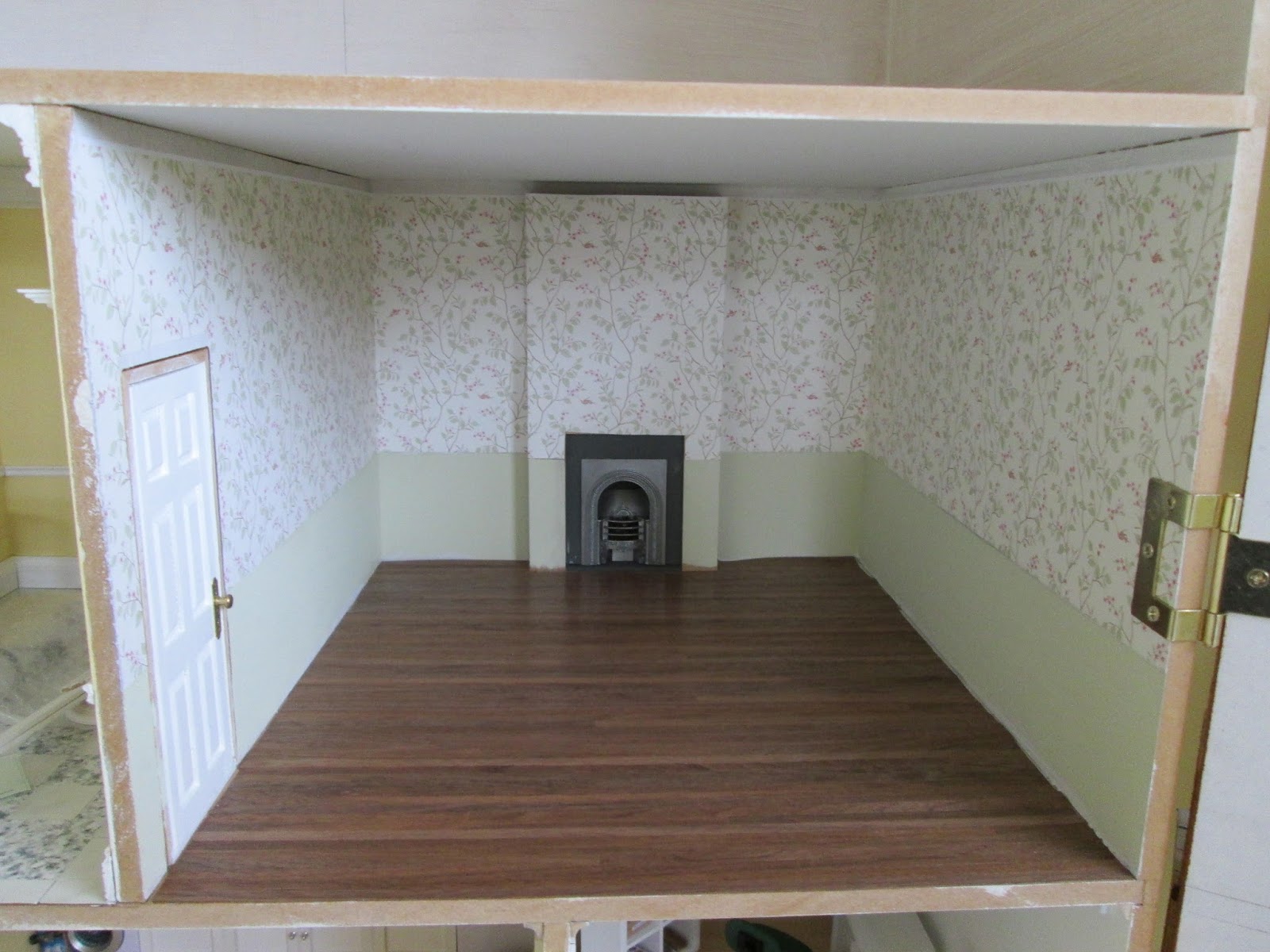
With the floor in place it was time to tackle the trims.

I like to sort out all trims I am going to need and paint them all in one go.  there is much to be said about cutting them ready to fit before painting; that way you aren't wasting time and paint on the waste which will be cut off at some stage further down the line.  I prefer to just do strips ready in case I make any mistakes working out joins.  That way I know I can cut and re-cut joins if I need to without having to stop and paint a piece of wood.


counted and painted

The coving is painted with white matt paint to match the ceiling as they should be made of plaster.  The wooden trims are painted with white satin.  Everything I use is water based as I hate clean up.


They have at least two coats and are denibbed (lightly sanded) between coats.  I use a decorators sponge and brush the routed grooves with a paintbrush and dust thoroughly with a soft cloth.  if you feel the trims before and after with you hands you will find what a huge difference it makes to the final surface finish to remove the nibs of wood.

denibbing 'kit'


White the second coat dried I put in the fireplace surround and hearth ready for the skirting and dado rail trims.


surround and hearth super-glued in

The door also need it trims in place so I would know where the dado rail and skirting came to.

door all trimmed

I started at the top of the room with the coving.  I found it an absolute nightmare working round the chimney breast, especially as it is such a shallow one.

Don't despair if your joins look like this


some nasty gaps

They just need a little paint shoved into the gaps and all will be well.  this photo is cruel and still makes them look pretty awful I assure you in place they look just fine.


paint-filled gaps


I do exactly the same with all the joins in the room - just blob generous amounts of paint in the gaps to fill the spaces.  Sometimes I also mix paint with sawdust if the gap is a bit too much for just paint.  There are various wood-fillers you could buy but the gaps are so fine and in such a cramped place I can not imagine having to work with them to get a decent result

The trims are all glued on with basic wood glue but I do add a couple of blobs of gel superglue just to grip them in place while they dry out.


With some fiddling of this and that around the fireplace and it was done.  Not thrilled with the skirting around the fireplace and I will need to give it more thought on the next room before cracking on with it.

Meanwhile one sitting room waiting for its light(s?).


Merry Christmas.


(22/05/16)


Saturday, 17 December 2016

Floors - Sitting Room

I am sure I must have covered floors (accidental pun!) several times in my posts but I am conscious that not everyone finding a blog has the time or patience to back up and read previous posts; so, for them, and as my own record of the build, here's a brief look at the floor going down in the sitting room.  [If you do want finer details of how-to just click on the floors link in the left hand column and every time I've mentioned a floor, the post should be there.]

For this room and probably all of the remaining rooms I am using my very favourite flooring.  This is real walnut laid in perfect scale strips on a backing paper.  Mine comes from the States via Jennifers of Walsall so I know you can get it on both sides of the pond.  It is absolutely the best quality I have found for real wood flooring.


the best real wood flooring


First of all I make a template of the floor using real life wallpaper.  Make as many as it takes until you get a perfect fit.  Don't compromise or you will end up with problems later.


paper template and the cut floor being tested


Using the template I cut out the floor.  Be careful about making sure you lay the template the right way up on your flooring; it is too easy to flip the shape of the room and then nothing fits and you have wasted a (not-cheap) piece of flooring.  I always turn my flooring over face side down and then lay the template on top of that also face side down, mark up round the edges, and if there is no identifying cut out, for a fireplace for example, I also write which is the top right hand corner, so it doesn't get rotated when I put it in place.

The flooring is in two sections as this is a deep roomed dolls house.  I always start with the full depth of the flooring being used for the front section of the room.  This puts the join as far back into the room as I can get it, so if there is any issue with the join its not as visible from the front of the house.

The floor is then given two coats of water based, quick drying clear satin varnish.  You can choose a range of methods to finish the wood.  You may just want to leave it as it is but you won't get the lovely colour and grain of the wood.  You could just use use a couple of coats of clear wax polish, or a gloss varnish if you want a high shine or do a proper three or four stage wood finish - the choice is entirely yours depending on your skill and the required finish.  This couple of coats of varnish is fine for me.  Don't over-wet the piece, remember it is wood and wood and water are not happy companions.  After the first coat is dry it is best to rub down gently with very, very fine sand paper 400 is best 200 up will do; best of all use a painters sponge that is designed for rubbing down paint between coats.

Remove all the sanding dust carefully and work on a clean surface and apply the second coat.


first coat done

My floors go down with double-sided sticky tape as I want to be above to remove them should the need arise - repairing/replacing a light in the room below for example.

Only use tape that is as thin as ordinary sellotape otherwise the wooden flooring will stand away from the floor beneath .  I got out all my rolls to see if I could give you a brand name - needless to say they are all blank.  The wide roll is sold as carpet tape but it is very thin for that! They all look chunky here because of the wax paper covering the tape.  I promise you they are as thin, if not thinner, than sellotape when in situ.


very thin double-sided tape

I use a wide strip right across where the join will go and another wide strip along the front edge of the room.  Then I dot bits and bobs around to help hold the floor down nicely.  I don't bother around the walls as the skirting will clamp that down


waiting for the paper to be peeled off

Lay down the front piece first to ensure that the front edge runs perfectly along the exposed front edge of your floor.  Lay the joining piece behind starting at the joint and working away from you.  Use a soft cloth to rub it down in place.

You can of course choose the direction of the floorboards.  In real life they lay in the direction mine do here (across the joists).  Which ever direction you choose it is best that the floors in the whole house 'run' the same way. 

So here it is all done.....


(22/05/16)